On a genuinely wet day in Tokyo, the deciding factor is rarely whether a place has a roof. It’s the walk from the ticket gate.
The National Art Center, Tokyo removes that walk entirely. Its own access page describes the Chiyoda Line route in three words:
“Direct access from Exit 6”
Nogizaka Station, exit 6, straight into the building. No umbrella, no crossing, no arriving with wet shoes to stand on a gallery floor for two hours. It’s the same trick the Mori Art Museum manages through the Roppongi Hills concourse, and between them these are the two Tokyo museums we’d send you to first when it’s really coming down.
Get the station right, because the others are not the same
The address is 7-22-2 Roppongi, Minato-ku. Three routes, and only one of them keeps you dry:
- Nogizaka Station (Chiyoda Line), Exit 6 — direct access. No outdoor walking.
- Roppongi Station (Hibiya Line), Exit 4a — about 5 minutes on foot, outdoors.
- Roppongi Station (Toei Oedo Line), Exit 7 — about 4 minutes on foot, outdoors.
Almost everyone arrives at Roppongi, because that’s the neighbourhood name. Nogizaka is one stop away on the Chiyoda Line and it’s the one that matters here.
If you’re coming from Omotesando or Meiji-jingumae, the Chiyoda Line is already your line — which makes this an easy pairing with the Nezu Museum at Omotesando on the same route.
Hours and the Tuesday rule
- 10:00–18:00, with last admission 30 minutes before closing.
- Closed Tuesdays. When a national holiday falls on a Tuesday the centre opens and closes the following working day instead.
That Tuesday closure is worth holding in your head alongside the others: Miraikan and the Ghibli Museum also close on Tuesdays, and the Mori Art Museum drops to a 17:00 finish. A rainy Tuesday takes out a lot of Tokyo at once.
The flip side: this place is open on Mondays, when the Tokyo National Museum, Nezu and Teien are all shut. On a wet Monday it moves up the list considerably.
There is no permanent collection
Understand this before you travel, because it changes what you’re buying.
The National Art Center has no permanent collection on display. It’s a venue rather than a holding institution — it hosts special exhibitions and the large open-submission shows that Japanese art associations run each year.
Practically, that means:
What’s on changes completely. At the time of writing, Picasso, through the Eyes of Paul Smith runs from 10 June to 21 September 2026, alongside several artist-association exhibitions.
Ticket prices vary by exhibition, so we’re not printing a figure that would be wrong for your date. Check the current show before you go.
Some shows are free and some are not. The open-submission association exhibitions are often free or very cheap, and they run in parallel with the headline show. On a wet afternoon with no plan, it’s worth looking at what’s on across the whole building rather than only the exhibition you’ve heard of.
Why it works as a rainy-day stop specifically
You arrive dry. Repeated because it’s the whole argument.
It’s a short commitment. One or two hours suits it. Unlike a half-day museum, this fits into a broken day — it’s a good way to absorb the two hours between a cancelled plan and dinner.
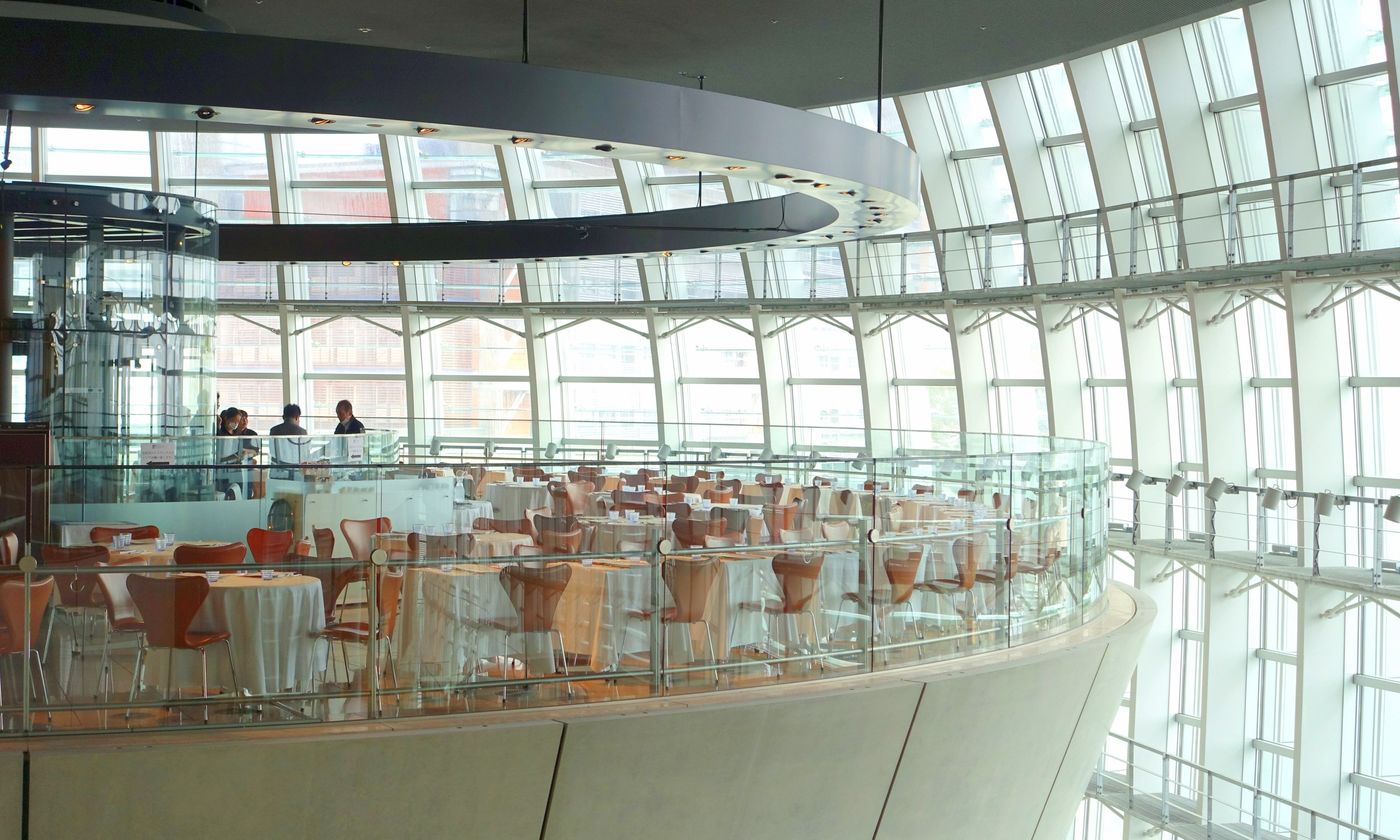
The building itself is worth the visit. The wave-fronted glass facade and the tall atrium give you something to look at even between exhibitions, and there’s café and restaurant space inside, so a downpour doesn’t force you back out at a fixed time.
It pairs with Roppongi. The Mori Art Museum is a short distance away and runs to 22:00 — so if you land here at 15:00 and the rain settles in, there’s an evening plan a few minutes away that also doesn’t need an umbrella.
Things the official site covers that are easy to miss
Three pages worth knowing about before you go, because they answer questions most people only think to ask at the door:
Discounts. There’s a dedicated discounts page. Since pricing is set per exhibition, whether you qualify for anything is also per exhibition — worth two minutes if you’re a student, a group, or visiting more than one show.
Accessibility. A barrier-free information page covers access provision. If a wheelchair or a mobility limitation is part of your planning, that’s the page to read rather than guessing from the building’s photographs.
Childcare. The centre publishes a nursing and childcare service page. For a family sheltering from a wet afternoon, an art venue that documents this at all is unusual, and it’s the difference between an hour that works and one that doesn’t.
We’re pointing at these rather than summarising the details, because all three change and none of them should be taken from a third party — us included.
Planning notes
If it’s a Monday: this is one of the few major art venues open.
If it’s a Tuesday: it’s closed. Go to Mori instead, before 17:00.
If you have two hours and it’s pouring: Nogizaka exit 6, one exhibition, coffee inside, out. No umbrella required at any point.
If you’re museum-fatigued: the association shows are a different experience from a curated blockbuster — hundreds of works by hundreds of people, and free or cheap. They’re an easy, low-stakes way to spend a wet hour.
Before you go
- Check what’s on. No permanent collection means the building’s content is entirely variable.
- Check the price for that specific exhibition.
- Nogizaka Station, Exit 6. Not Roppongi.
- Not a Tuesday — unless it’s a public holiday.
- Last admission is 17:30.
For a full wet-weather day, see our rainy-day Tokyo itinerary.